The Looming Merge

I've been picking at something a lot lately, like an itchy scab but inside the brain. It's not my OCD either, but a genuine chewing of a serious dilemma and the repercussions as it plays out.
Anonymity online has already died, but the merging of identities has yet to happen. In a very real sense, the train has already crashed, even if those of us in the rear coaches aren't aware of the visceral fallout just yet. We currently exist in this limbo where we perceive ourselves to have a degree of anonymity, yet in reality have none.
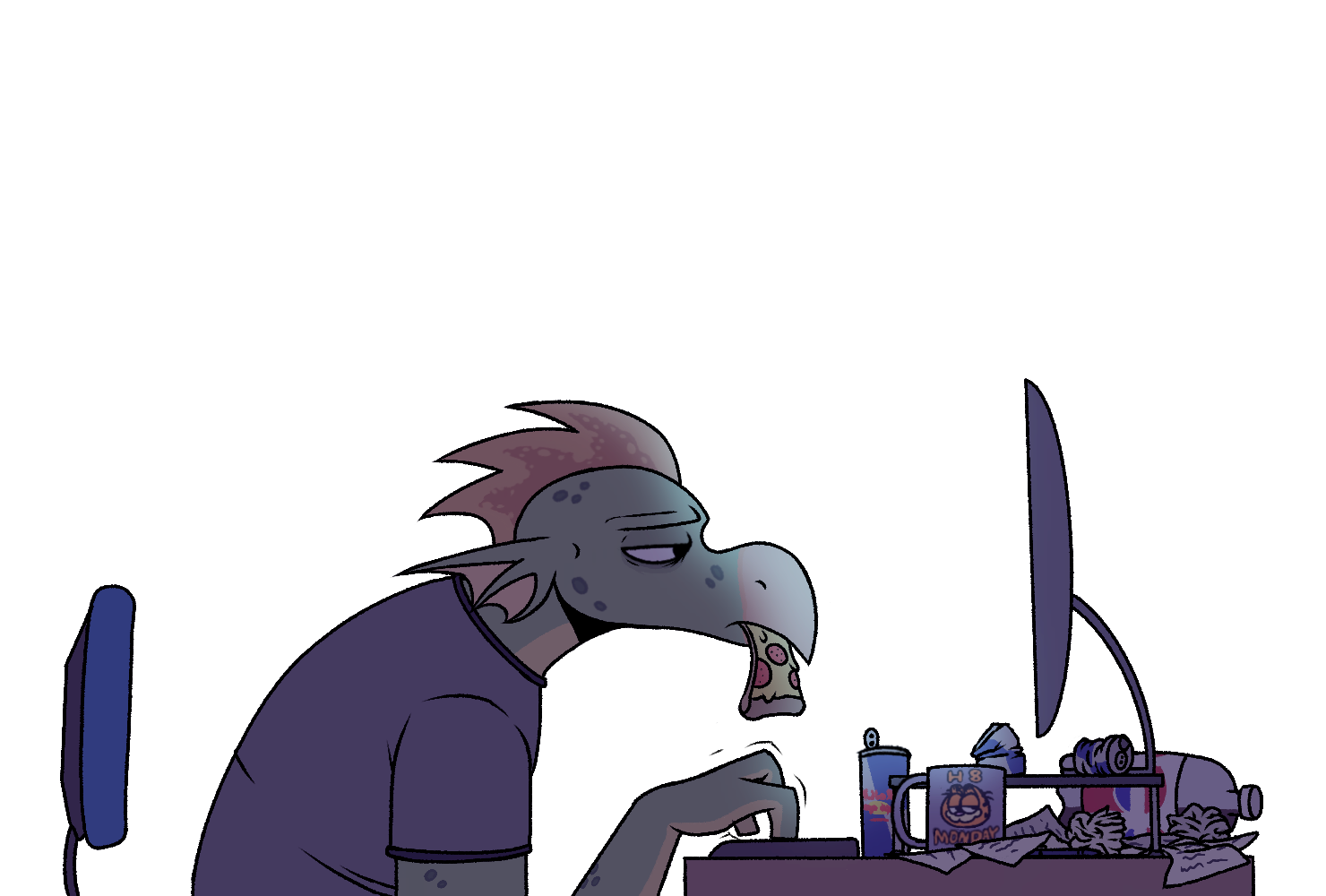
I'm no different, at least outwardly. I share my thoughts behind a pseudonym, a dinosaur on the internet who talks politics, technology, and systems as seen from my entirely subjective point of view. I have a NSFW social media account out there, as well as a more "professional" account on an entirely different platform. The two do not mix. I use multiple e-mail addresses and subdomains to try and hide that there's a single person behind these multitude of accounts, and for a while I believed that my identity was hidden well-enough so as not to cause me reputational harm.
In reality, I know that to be false. I have no doubt in my mind that there's enough data out there to connect them all together. Heated moments where similar content crossed enough boundaries that a machine was able to connect the dots, or a nation-state tapping the metadata of these services and seeing them all coming from the same IP address. I have long since abandoned hope of shielding myself from nation states - after all, my SF-86 got leaked along with millions of others - and I've worked on the very biometrics systems used to track and identify threats to power. I just assume every government knows exactly who I am and what I'm doing at all times, and carry myself accordingly.
Lately though, I've felt dwindling desire to maintain these individual personas and identities in the face of immense pressure from reality. When you're already a target for being a faggot and an opponent to authoritarianism, trying to hide one's authentic self from others feels a bit like bailing water from the Titanic with a martini glass: an exercise in futility. Even if I do not flaunt these sides of myself to employers or fellow professionals, I increasingly see no need to hide them either: the layoffs will happen anyway regardless of what I do or who I am, so why bother maintaining appearances to make the person laying me off feel more comfortable with themselves?
The American push into a surveillance economy, where video doorbells surveil everyone at all times and whose content is uploaded to YouTube or altered for clickbait, compounds my concerns immensely. Americans, so fearful of anyone and everyone else, react with hostility towards those of us who feel threatened by the growing presence of cameras in our everyday lives. One such neighbor openly threatened to call the police on me "since you're scared of them", so furious was she at my holding my hand in front of her obnoxious doorbell camera in a hallway and preventing her surveillance of my person every time I was going to or coming from my car in the locked garage. Raising my grievances to the landlord was met with a shrug and an offer to move my space so I would not pass by her camera, a tacit approval of further weaponizing of surveillance in areas believed to be private, or at least secure against the general public trespassing within.
Anonymity is dead in an era of commodity surveillance and machine learning, and privacy has two feet in the grave along with it. Hundreds of millions of people who grew up online with pseudonyms, screen-names, channel brands, and streaming personas, will see those thin gaps between real life and digital life collapse in the face of bad actors with an axe to grind and a negligent political class who sees no harm in tracking their enemies' movements and ideologies for exploitation. Streamers and content creators in particular are already on the front lines of these battles.
I'm watching Serial Experiments Lain for the first time, and am halfway through the series. I find it oddly prescient that a core plot point is the divergence between "Evil" Lain on the Wired (i.e., the internet) and "Good" Lain in the real world, as it reflects the continued cowardice of bad actors online behind anonymity while simultaneously stripping it from their opponents as a weapon.
Anonymity is safety. Stripping that safety is irreversible, and that's the point. Once you have been doxxed, there is no way back into anonymity.
I'm curious to see how the series ends. Don't spoil it for me.
In the decade ahead, as geopolitics shift, surveillance expands, governments demand age verification tools, and AI reaches more miscreants and bad actors, the identity merge will almost certainly happen to a significant degree. I already see it in my circles, younger people no longer hiding their faces or locations because there's not much to lose anymore when the economy is bad for working class folks, when the government wants them jailed or dead for merely existing, and when systems that promote homogenizing or conservative behavior - job tenure, homeownership, community programs - are completely out of reach or outright destroyed. The incentives to hide one's self are gone, and the tools to strip anonymity are everywhere; may as well be your most beautiful, bold, authentic self possible, at least until the government executes you in broad daylight anyway.
The net result, I hope, is a forced reckoning with reality for people on every side of this argument. For all the crowing conservatives do about cancel culture and censorship, they're the ones presently hiding behind masks while routinely violating the law; this shift to public identities will strip them of their shield just as it does the protestors demonstrating against fascism and overreach. Most everyone will be readily identifiable, for better or worse, and held to account accordingly by the court of public opinion.
Politicians and proponents of this change say they support it, but as the Epstein files may very well prove, that sort of transparency does not work in favor of those doing actual crimes or violating social taboos. By the time the masses realize the train has already crashed, it'll be too late to undo the damage done to privacy and identity.
In other words, to paraphrase John Mulaney: "Everyone better get real cool about a bunch of stuff really quickly." If the popularity of current content is any indication, the younger folks will almost certainly be fine while conservatives and older folks will likely engage in performative pearl clutching.
Perhaps that's the natural order of things, where anonymity and privacy swing like a pendulum: in times of crisis, authenticity matters more than anonymity and thus more people drop the mask in favor of bold action, while quieter and safer periods promote masking, hiding, and retreat so as to avoid harming hard-fought gains. Or maybe I just have it backwards, or I'm seeing something that isn't there. Being wrong is always an option.
I bring all this up because I had to respond to an email today, someone who went through the diligence of finding my contact info and sending me a message with their real name. I could've easily responded from the pseudonym account, but the calculus this time around was that doing so would hinder my ability to find gainful employment and possibly rob me of a meaningful connection with someone who took the time to compliment my work. On the other hand, there's still significant societal pushback towards anyone tangentially orbiting the "furry" subculture, and I struggle enough as a gay man without having my personal proclivities dangled like a Sword of Damocles overhead by those who could control my career prospects.
I chewed on it a bit before responding to the message with my actual e-mail. I extended a bit of trust, hoping it would not be weaponized against me.
And perhaps that's the best we can do in times like these: trust each other a little more.