
Too Complex to Fix

The social gestalt seems to be particularly aligned lately. That, or I’m just seeing patterns in coincidences. Everyone wants to solve complex problems making human life increasingly miserable - housing, wages, cost of living, transportation, healthcare, education, employment - but perfectly intelligent people spend months, years, decades unraveling these complex webs of systems and entities and money transfers before reaching the same conclusion:
“It’s too complex to fix.”
i. American Healthcare
Andrew Tsang put together an amazing post on the American Healthcare system in comparison to other countries, including an amazing graphic I’ve blatantly copied below.
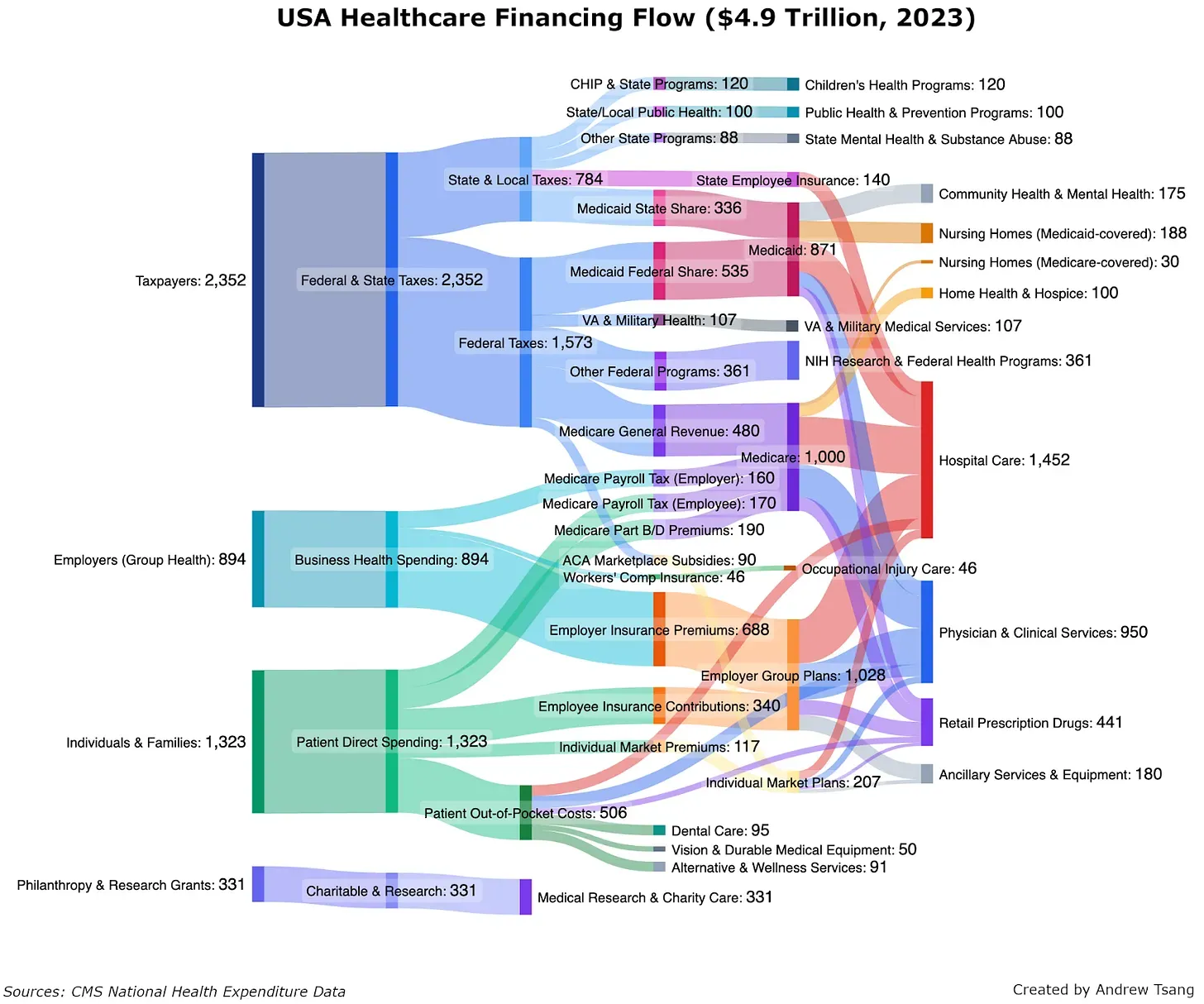
The first reaction I had on seeing this was, “Holy shit, no wonder US Healthcare is broken.” After further reading and reflection, I agree with Mr. Tsang’s conclusion:
We built a system that costs everyone, everything, everywhere - and we’re still arguing about whether healthcare is a right, an earned benefit, or a market commodity.
I spent weeks mapping this diagram. Actually taking away parts? That’s choosing who loses coverage, whose job disappears, which hospital closes.
Thus healthcare becomes too complex to fix.
ii. Housing Crisis
I don’t have such a fancy chart for this next section, but I also don’t think anyone needs such a visual for something so intrinsic to our daily existence that all of us, deep down, know it’s a crisis of multiple fronts.
When we blame Private Equity and REITs for gobbling up housing stock, they blame market forces (shortage of supply, higher returns than other asset classes). When we blame market forces, the entities behind those forces direct us to governments who hamstring new developments behind “regulations” and zoning laws. When we go to yell at the government, they spin us right around and turn us towards entrenched homeowners who refuse to allow more housing to be built, who nitpick style guides and demand public comment on if a house can have a rooftop deck without harming “neighborhood character”. When we yell at them, they point us right back at governments that block new developments, REITs that hoover up stock for renting, market forces incentivizing hoarding of housing stock, and also how much taxes they had to pay this year as their property appreciated in value - a property that’s meant to be their retirement nest egg, so it has to appreciate in value even if they can’t afford the tax payments on it.
It’s patently ridiculous to continue entertaining any single entity’s argument for blaming someone else, because they’re all to blame for creating and perpetuating a system that’s too complex to fix by design.
iii. Organizations
We’re in a moment of what should be generational transfer of power in organizations, as older workers move into retirement and younger workers take the reins, set policy, and drive the future.
This is not what is happening.
We’re instead entering organizations rife with political strife and outdated processes, built atop layers of band-aids and pilot projects in lieu of proper strategy and continued investment. Existing leaders don’t want to hand over their empires because doing so robs them of the power and wealth they attained for themselves by wielding these entities like weapons. It’s why politicians skew woefully geriatric in a society desperate for younger voices and ideals, and it’s why board rooms and C-suites age ever older, ever grayer, ever more removed from the plights of their workforce or needs of the organization to survive the decades of tumult ahead.
We’re forced to either spend time investing in our ability to do our jobs in an ever-downward market, or investing in our ability to operate politically in the same, backstabbing, sociopathic manner as our “leadership”. Given the ominous clouds on the horizon with AI displacement, climate change, geopolitical instability, and a polycrisis not seen since the downfall of Feudalism itself, we’re understandably more focused on survival than profit.
Thus organizational politics and power becomes too complex to fix.
iv. The Others
The same rationale can apply to a myriad of other crises. The climate crisis (fossil fuel industries, renewable industries, utility providers, shareholders, logistics systems? Too complex to fix!), the banking crisis (banks, shareholders, investment firms, complex instruments and securities, infinite depth and complete opacity? Too complex to fix!), the manufacturing crisis (market incentives, resource pipelines, logistics systems, shareholders, lack of specialized labor? Too complex to fix!), the education crisis, the transportation crisis, the partisan crisis, the social media crisis, the AI crisis.
All crises, all too complex to fix.
I am sick of that shit.
v. The Example
I had a client, once, who loathed their work processes. Purchase orders had to go through a lengthy process of documentation, approvals, and both physical and digital filing. Their physical space was specifically laid out decades prior, and everything they claimed to now need (hotspots and Wi-Fi and cameras and scanners) had to be retrofitted into existing processes, rather than old processes modernized into something infinitely more effective.
Too complex to spend the money to fix, we were repeatedly told.
And then the business burned to the fucking ground. Physically and digitally, that is. Monstrous fire took out their main campus overnight along with their records and most of their equipment. Yet they still had customers to serve, obligations to meet, and an insurance policy payout to rebuild from.
They had a blank slate, and we ran with it. Truck rolls declined, because we could finally bake-in secure remote capabilities from our head office to theirs. Their Wi-Fi got better because we could work with building designers to identify ideal placement points. Technology wasn’t an after-thought or a band-aid, but a revolution in how business got done. We had the runway, the budget, but most of all the acceptance that the problem was too complex to fix, and thus had to be thrown out entirely, pain be damned.
That client is still doing decently well for themselves last I checked. Even expanded into a new facility.
vi. Complexity is the Problem
When someone says a system or entity is too complex to fix, my knee-jerk reaction is to punch down hard against that idea, early and often. Blaming complexity is the coward’s move, it’s the rationale that those entrenched in said systems are hoping you lean on so that they have time to adapt to change, should change ever arise in the first place. We see it everywhere, all the time, with inevitability being the runner-up for bad decision-making.
A problem isn’t too complex to fix, it’s more that too many other entities benefit strongly from it not being fixed. That is the complexity of the American economy, and a key reason (I suspect - personal conjecture territory) for why the American stock market and GDP keeps exploding compared to EU or APAC neighbors and allies. We shove middlemen into transactions between other middlemen, inflating valuations and adding complexity in the hopes that regulators and the populace give up rather than fight for something better.
What this rationale of theirs misses, though, is the breaking point when it’s cheaper to burn it all down and start again, than it is to continue engaging in discourse or debate with those who have the most to lose from any change whatsoever. I feel we’re rapidly approaching such a point, as evidenced by rising populism worldwide over the inability to afford basic necessities of life even as our working lives consume ever more of our finite time alive. Silicon Valley monsters are demanding Americans capitulate to China’s 996 culture, even as Chinese young people protest against it through silent, stoic refusal or “performative labor.”. American financiers demand lower costs of debt for businesses and lax regulations on their products, even as they raise rates on consumers and entrap us with regulations prohibiting debt discharge, all in the face of open support for gambling of all stripes (casinos, sports betting, even shit like Polymarket). Sure, these endeavors succeed in fleecing more of the ever-dwindling amount of money from the impoverished working classes, but we’re stretched so thin that we have nothing left to give - thus they now turn to algorithmic pricing in grocery stores to make number go up.
Yet when the breaking point is eventually reached and people are willing to throw out these entire systems of arbitrary complexity into the bonfire of bad ideas, who is going to protect the people arguing so fiercely against any meaningful change whatsoever? Do you think Larry Fink or Jeff Bezos or Elon Musk are going to let you into their bunkers when the electorate demands the severed heads of politicians who took their greasy bribes lobbying payments and campaign donations? Do you think Mark Zuckerberg or Larry Elison are going to give you space on their private Hawaiian estates for being their loyal keyboard warrior? Do you think the foreign oligarchs snapping up condos and apartments in major metros as an investment hedge are going to let you crash on their sofas as thanks for blocking that ghastly high-density housing nearby?
Too complex to fix only works until enough people are willing to burn it all down, convinced that it is indeed too complex to fix.
Addendum: Nobody wants to be the Loser
Several years ago, I took a cross-country Amtrak trip as a treat for myself. I got to meet a swath of interesting people from all across the country: an older woman heading back to her ranch in New Mexico, a honeymooning couple who scraped together all they could to afford an overnight roomette between Chicago and New Mexico, some “political fans” who wanted to commiserate over conspiracy theories with anyone who would listen.
Well, I did listen. As quite possibly the only queer person in the dining car in the midst of a desert, I listened intently. I listened to everyone complaining about the same problems - housing, COVID restrictions, cost of living, inflation, politics - and I picked up on two key consistencies during this trip of mine:
- Those who suffered harm from society improving (mask mandates, eviction moratoriums, stimulus checks) would loudly scream that problems were too complex to fix, or that they didn’t understand why they had to sacrifice for others.
- A stubbornness from everyone towards the idea of anyone having to suffer harm for societal change or improvements.
And so, after listening to a particularly exuberant political fan espouse their loudly-held opinions to an Amtrak staffer over breakfast, I finally chipped in my own two cents: “The real problem is that nobody wants to be viewed as the loser.”
The dining car fell silent aside from the loud rumbling of wheels on shitty freight rails, as everybody processed that statement. “Well, I guess that’s true,” was the only retort from the portly gentleman in the gym clothes and bright red cap, before he and his companion decided they had finished with breakfast.
That stuck with me. Everyone views themselves as having to win on every transaction. In a society where everything has been turned into a transaction, it means the populace is treating their life like a scorecard - and most are seeing it consistently add up to a big, fat zero, no matter how hard they try. Nobody wants to sell their home below market value, because that’s a loss. Nobody wants to keep workers on at the expense of a point or two on their profit margins, because that’s a loss. Nobody wants to let high-density housing or public transport expand into their neighborhood, because that’s a loss. Now bake in gambling, and microtransactions, and algorithmic pricing, and all the trappings of the current modern economy, and it’s so glaringly obvious that nobody wants to be the loser - even if trying to become a “winner” means harming everyone else around them in the process. Hell, you could extend that to the current AI race, where everyone is moving so quickly despite the risks and harms because nobody wants to be the loser, consequences be damned.
I think a substantial amount of the work needed to convince our neighbors and fellow humans to embrace change as a fundamental concept is that change doesn’t have to necessitate winners or losers, it just is. We can make systems and rulesets that don’t incentivize exploitation and complexity, that mandate humanity and compassion instead. It’s possible, it just requires a willingness to accept that we have to throw out a good chunk of the systems and institutions that power our modern lives today.
It requires acknowledging that if nobody wants to be a loser, then we must fundamentally build a society where nobody can be a winner either. Given the scorecard most Americans look at (their net worth and bank account balances), I think most would agree with that core conceit:
They’re so tired of losing, that they’re willing to build a new system where nobody, even they, can win.