VR Changes Things
The internet has been my primary method of social interaction since grade school. This was back in the late 90s, in an era of AOL keywords and YIM chatrooms; an era before profile pictures were the norm, when language skills were of lesser import than technical skills. The reason for this simple enough: my family moved every few years, obliterating my social circles in the process like a nuclear bomb. The internet became a way for me to make - but far more importantly, keep - friends, regardless of distance from me; the fact it enabled me to meet folks from all over the world, of different backgrounds and creeds and nationalities and time zones, was an immensely huge bonus that I was all too eager to take advantage of. While my peers wanted to keep in touch locally regardless of interests, I wanted to keep in touch with friends who shared my interests regardless of location, for the very reason that my location was fungible.
This played out along an expected arc, for those familiar with millennial socializing in the 2000s: I gathered my cadre of messenger clients to reach as many friends as possible, sitting on AIM, ICQ, MSN, YIM, Skype, Jabber, and IRC for hours at a time. These coalesced behind Trillian, then Pidgin, before the companies behind the centralized platforms began enshittifying them and newer upstarts made certain features far more accessible. IRC remained a stalwart all the way until Discord stormed onto the scene, while the casual interactions of DMs gradually moved onto more public platforms like Twitter - and then immediately retreated back into the faux privacy of DMs, as randos began critiquing or harassing any deviation from their subjective norm.
The common thread between all of them, at least for me, was identity: with little more than a screen name and, maybe, a profile picture, I could forge the identity I chose for myself instead of one foisted upon me by outsiders. In meatspace, I was the eldest child being the role model, taking college credit during High School, wearing designer polo shirts and khakis, constantly being shoved onto the next challenge with expectation of immediate success. Online, the canvas was blank, with zero expectations placed upon me other than to not be an asshole. Initially, I used a screenname that was little more than a portmanteau of my first name and latter initials, bringing my real self into online spaces.
That...never felt quite right. It wasn't merely the privacy implications of using my real name in virtual spaces, but also this feeling of immense weight holding me back from being my best self. I kept to myself in games, mostly, never engaging much in conversations with others beyond trading barbs. It felt better than real life offered, but not by much.
Then, in my Freshmen year of High School, I discovered Otherkin and, by extension, Furries.
The Blank Canvas, Revealed
Remember when I said the online canvas of identity was blank, and had zero expectations placed upon the user? That report for social studies class on Otherkin was the moment I innately realized this reality for myself. My classmates emphatically did not understand that, but to be fair to them, they weren't the ones being bullied for merely existing at that time. To someone like me specifically - lacking in direct social connections due to the repeated destruction of relocation, bullied in the real world, feeling as if I'm putting on an "act" for everyone else's satisfaction - this was revelatory in a way I can't really describe in words.
I found myself standing before this blank canvas, a fresh set of artistic tools at my disposal. The task was simple: "draw yourself, as you want yourself to be, to everyone else." I was not a visual artist, but I loved reading fiction and writing (cringe, trashy) short stories. So I began with a new screen name, a new set of social accounts, a new handle on IRC, and began exploring not just the digital space at my fingertips, but the person within I'd neglected for so long.
The response was immediate and positive. Instead of trying to insert myself into conversations in IRC where I often felt like a hanger-on, I found myself confidently dropping in and out with personal agency - and reached out to intentionally by others, a novelty to me at this point. I became invested in the underlying technologies and commands as a means of furthering my own self-expression (/me changes his password to 'hunter2'), exploring this swath of the internet awash in unique, colorful, and intriguing art, and meeting the people inhabiting it.
A quick tangent on sexuality, as any discussion of identity in one's teenage years is bound to contain.
This exploration dovetailed conveniently with a gradual realization of my own queerness, manifesting as homosexual attraction. To be clear, these signs were visible long before learning of the fandom - I'd had typical puberty awkwardness in Middle School, necessitating a deathly aversion to the men's locker room - but the fandom certainly made it easier to explore these feelings in a safe space. Furries didn't groom me; if anything, it could be said that I wouldn't have stumbled across the fandom had I not already been searching for answers related to those feelings of my own accord, lacking in trusted adult guidance or media representation to address them in a healthy way.
On that note, it was also refreshing having so many adults in the space who asserted very clear boundaries, even back then. In AIM or YIM, discovery of my (under)age was met with substantial outreach by adults; in contrast, admission of my age to the fandom was met with firm sequestering away from adult spaces, topics, and content, for my safety as much as their own. The attitude was very much like the cliche of parents discovering the stash of nudie mags under the mattress: "We can't stop you from passively observing our spaces, but we can protect you by barring you from entering or remaining in them once found."
Adults in other spaces clearly lack such attitudes.
Even as I explored, however, I was constrained by the limitations of media and imagination. Chat - a text based medium - allowed for ample expression and exploration of scenes, but my imagination struggled to put those into shapes and colors. As I took on work and had money to spend, I began exploring text ideas through visual media by commissioning artists. This was closer, but still "far" from this feeling of wholeness I felt I was missing. I joined comics or projects with others built around themes or ideas, but this didn't bring about the sense of fulfillment or community I'd been hoping for. I wrote my own fanfiction (as cringe teenagers do), but that also didn't bring about the desired results - though it did produce a "floor" to remind my future-self how far I'd come as a writer and artisan in my own right.
I meandered a bit, for quite a while. I explored more in physical space - munches, cons, events, parties, gatherings, game nights - and my social networks grew accordingly. I couldn't quite put my finger on what felt "off", or why, and so I assumed it was something material: maybe spending more on a hobby would "fix" me, or doing a bigger/grander display for recognition. I commissioned my own comics and art, rather than partner with others. I continued painting, filling in my own canvas, and yet it always felt "empty" or "missing".
From an outsider's perspective, I was on the up and up: solid career growth, spacious flat, helping others with my excess, lots of friends, lots of nice things, and growing savings balances. The external consensus was I had my shit together.
And then COVID hit.
Dysmorphia Emerges
COVID force-equipped me with a number of simultaneous triggers: isolation I'd not experienced since childhood, the legalization of cannabis, the availability of mental healthcare, a stable job in an unstable world, and time.
I built a new gaming PC with the proceeds from my job at the time, shoving an RTX 3090 into it since the 3080 was perpetually out of stock (ominous portents of shortages yet to come); this came with an HP Reverb G2 headset that was used primarily for the likes of Elite Dangerous, Half-Life Alyx, and Beat Saber. I started a weekly Jackbox game night for some friends (that continues going strong today, albeit with a smattering of different games beyond Jackbox alone), manning the proverbial lifeboat as my energy allowed.
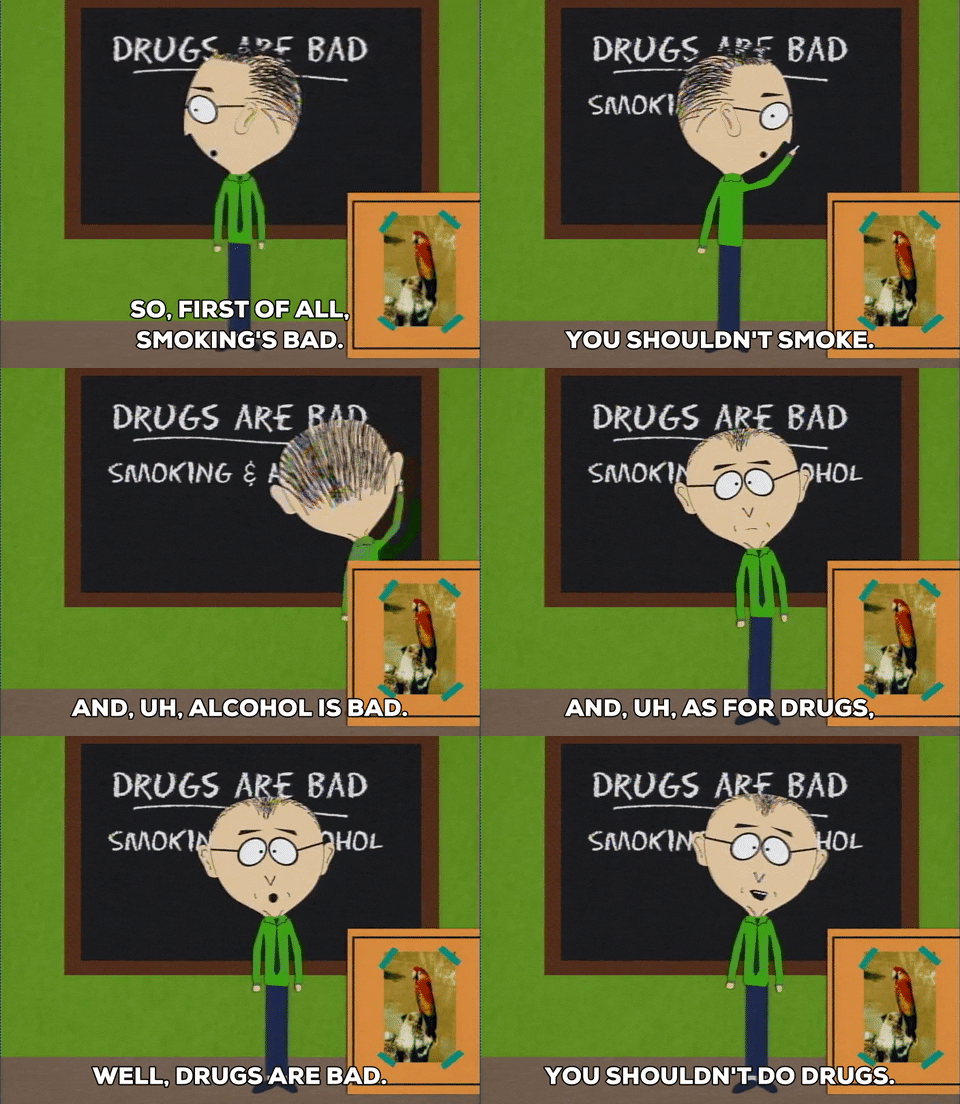
I also got my first taste of cannabis. See, I'd always been a Boy Scout in the literal and figurative sense, in a way that could best be described as "Mr. Mackey with common sense."
Plunged into a world where I'm walking every day for fresh air and exercise, but not driving anywhere due to lockdowns, I was extended a very reasonable offer by a good friend: try some, because this is as safe a time and space as you'll ever get to do so. He offered me some LA Kush Confidential in a 310 cartridge, and I went for a walk.

I came back home and, after coming down from my first ever high, I resolved to schedule an appointment for a neuropsychiatric workup as soon as possible. Having the ability to pause, focus, and think for the first time in my life without a cacophony of noise going on inside my head was enough of a profound change that I simply needed to understand if that was the norm, or if I had something hindering me.
The inside of my head on a normal day; open in seven to fourteen different tabs on repeat and slightly out of sync but at different volume levels for a general idea of how I run on a daily basis.
My experience with cannabis was so profound that I'm still working on a separate post about it. Needless to say, I'm a believer.
Anyway, the workup happened sooner than later and resulted in a few years bouncing between psychiatrists and therapists as we tried to identify the underlying issues and if there was a diagnosis to be had. The end result: Obsessive Compulsive Disorder manifesting in mental rehearsals instead of physical rituals, an auditory language processing disorder (hence why I've always struggled in lectures or with some singing styles), and likely (but unprovable) childhood autism since masked through self-developed coping mechanisms. Oh, and a lifetime of FPS boomershooters put my reflex skills well above and outside their standard range; that was amusing to learn.
So...yeah. There was something wrong, turns out. I cannot express how much of a relief that was to hear from qualified professionals.
During the requisite therapy, the suggestion from my therapist was that a trigger for my OCD (and my subjective executive dysfunction) may very well be a lack of authenticity in my lived life. The theory was that I spend so much time worrying about my masking, that it's triggering neuroses around that mask faltering in some form, resulting in rituals to re-evaluate and re-apply that mask. She walked me through Cognitive Behavioral Therapy, equipping me with the tools necessary to interrupt the cycle while encouraging me to be my authentic self more often, more openly, especially at home.
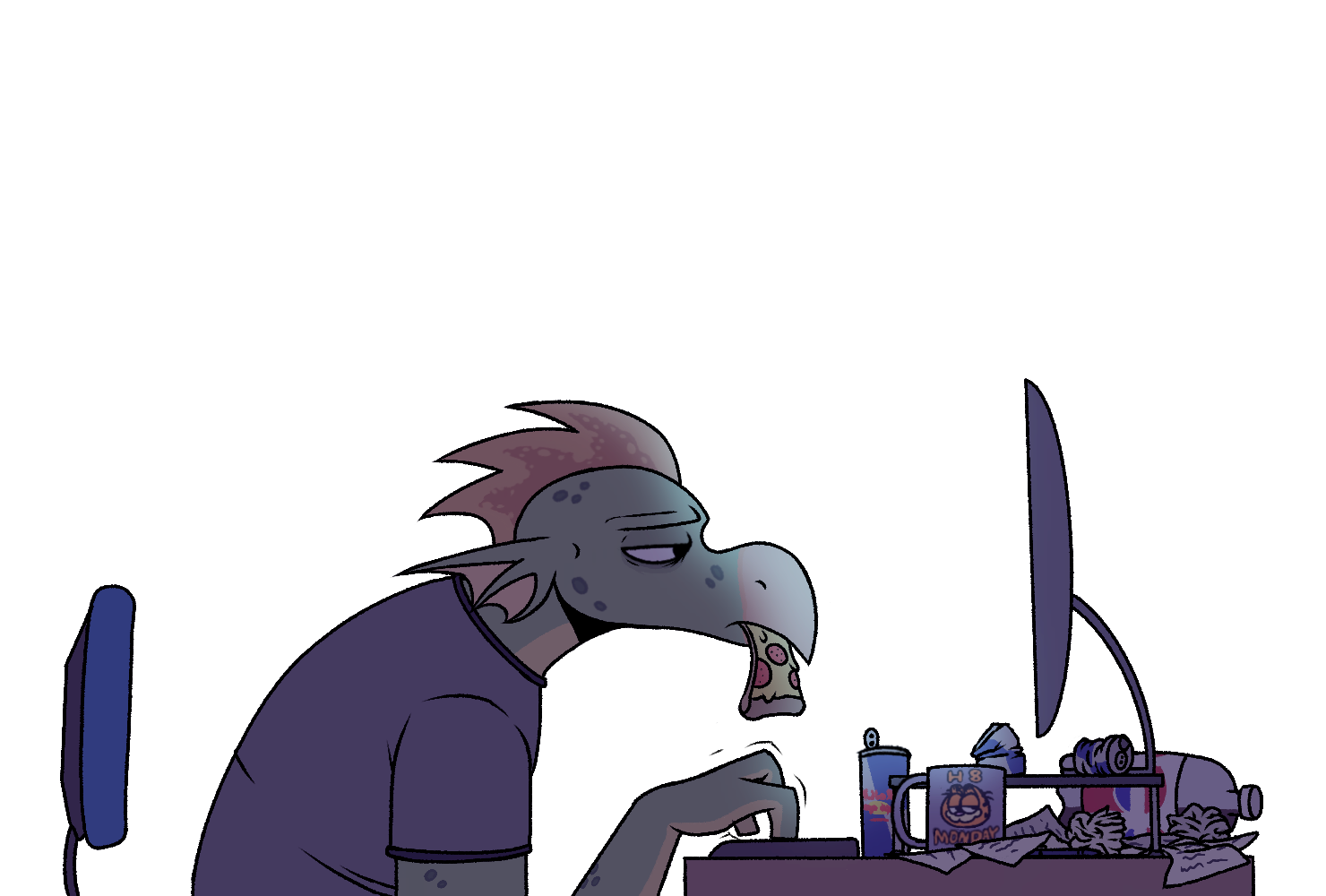
Around this time, a Discord server for an artist I follow began hosting VRChat meets. I signed up, equipped the headset, and figured I'd give it a go to see what all the fuss is about. At first, this was a familiar routine from my earlier explorations of Second Life: find an avatar "store" (or in VRChat's case, "world"), find something you vibe with, and roll with it into worlds with friends to get up to shenanigans. I found a simple enough lizard-looking thing whose shapes I liked, threw it on, and...
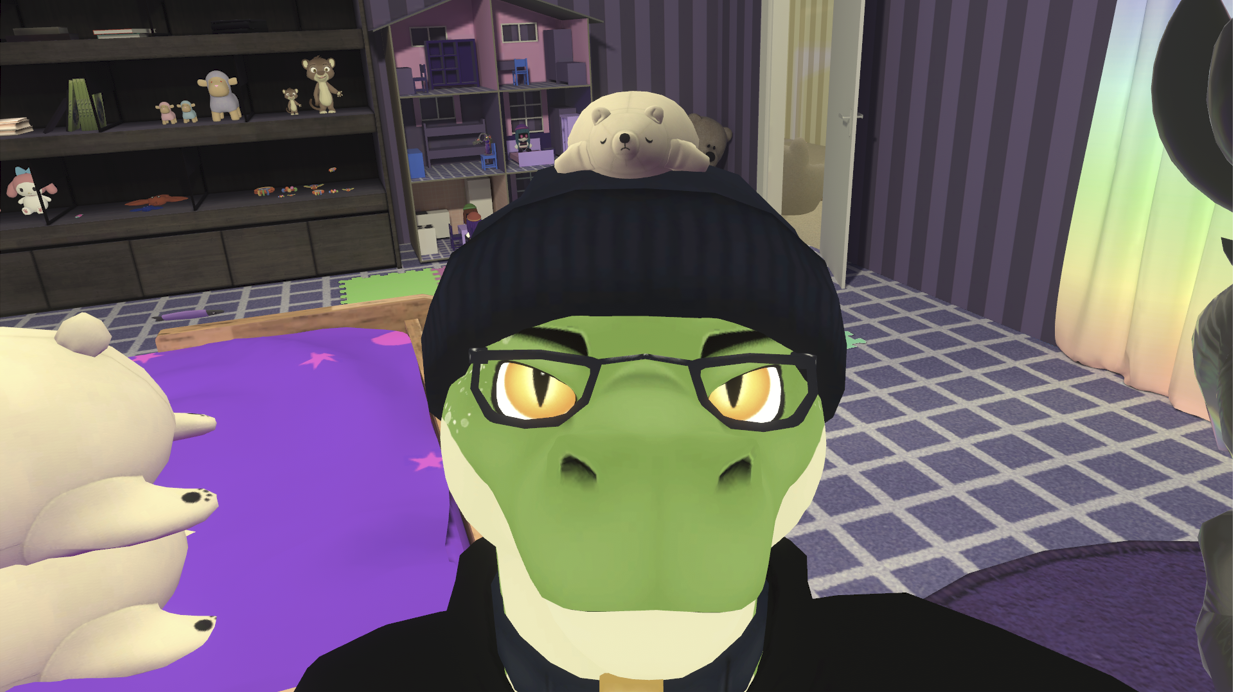
VR is not the same as prior social infrastructure or experiences. In Second Life, you're commanding an avatar with your keyboard, mouse, or gamepad. Your camera perspective is flexible, being first or third-person. It is very, abundantly clear that you are not the avatar, merely a remote operator for it. The character on screen is not you, and never can be.
This is not the case in VR, because of its very nature. You are the avatar. Its clothes are your clothes; its perspective is your perspective; its actions are your actions. A good headset and rendering experience almost "short-circuits" the brain's own perception mechanisms, yanking you out of the meatsack you inhabit on the daily and throwing you into whatever the hell you want. Even though you physically feel the cheap, weird plastic controllers in your hands, when you look down at them in the environment and squeeze the triggers, your in-game fingers wiggle and bend accordingly. Your mind quickly adapts to the new neurological mechanisms: making a fist means squeezing the index and middle-finger triggers together, while pointing means just squeezing the index-finger trigger. I routinely watch folks with FBT - Full Body Tracking - perform complex gestures with their hands and fingers that I would think impossible in a traditional game environment.
Watching someone flip you off in VR is an experience, because there's enough data there to trick the brain into believing that's a real person behind the poorly-optimized avatar and shitty framerates. You know that person is decked out in fancy controllers and trackers, but to see it in VR is just so astounding and grounding in equal part that it's difficult for me to put into words.
And that extends to your perception of yourself as well. Remember when I mentioned the brain quickly picks up the shift in patterns and movements for your hands? Well, it also forms a "bypass" around your meatspace self to connect your virtual form directly to your mental processing. It's the equivalent of looking down at your hands in VR, and finding them more plausibly real and satisfying than whatever you have in the real world. It's dysmorphia in a very real sense: this is me, and I prefer it this way. No surprise that mirrors are so damn popular in VRChat: when we recognize a version of ourselves we find authentic, we seek to relish our success and confidence through self-appreciation, or even vanity. I do the same outside of VR as I've lost weight and experimented with clothing, admiring myself when I look good and authentic to my own eyes.
I went through the same process in VRChat myself: I found a shell that was far more reflective of who I wanted to be, and how I saw myself, than my actual body represented. I could explore themes, spaces, and ideas through the full immersion of VR, and without the consequences of real life. I have repeatedly fallen asleep in my headset beneath wintry snow or next to a crackling fire, only to wake up sometime later, raise my virtual hand above my head to futilely block the bright light from my headset against my eyes, and thought, "this feels right."
I am not me in VR, not yet, but I feel far closer to filling that "hole" in my canvas via VR than through any prior means.
The Ongoing Journey
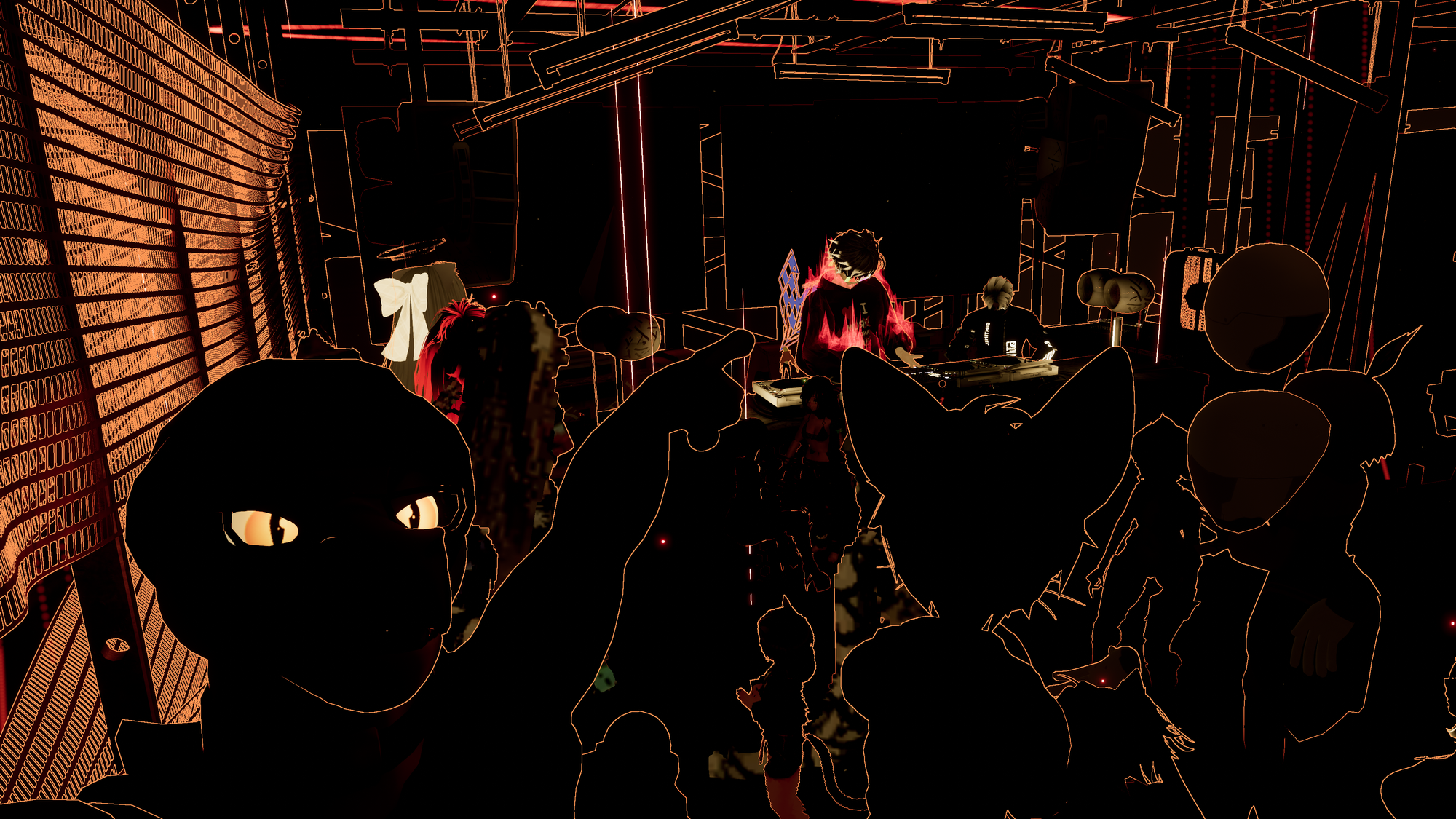
Last night was yet another meetup. I went to it, hung out, chatted with some folks about topics I didn't really want to talk about, engaged in some mutually enjoyable pranks and teasing (VR physics are fun to abuse), and then fucked off to a nightclub. I danced to a live DJ set, took a hit of some shader "drugs", and danced some more. I ended my night talking to a friend I'd met via the platform, a small bird creature with a Monster Energy baseball cap and a quilt-like outfit. I dangled my legs off the top of a skyscraper, drum and bass behind us as we talked about cocktails, alcohol, performance optimization, and the blessings this device and this realm have given us. I found myself leaning to my right, angling my ear towards him to hear them better, just as I would a friend in real life at a real club.
For all the doom and gloom about VR and tech in general, I'm optimistic this is just the start of the wider journey for the experience. Headsets have become portable, wireless, powerful, cheaper, and lighter. Controllers get better year by year, as do body trackers. What once required extensive scripting and technical knowledge can now be bought in a box and setup in an hour, sometimes without a PC in the mix at all. My reservation is that platforms like VRChat rely on centralization that gives bad actors power over oppressed groups - like queer and BIPOC people. Decentralization continues to expand, but the nicheness of VR means said efforts have not seen much success in that realm.
I genuinely worry about the long-term viability of VRChat as a going concern, and I'm not alone in this. Even so, it's encouraged me to improve my own technical chops, to advocate for more diversity in hosting and subsistence in this beautiful place to preserve it for decades to come. I've even forced myself to begin learning Blender, in an attempt to turn my own character sheet into a personal model, fully reflective of the canvas of my identity I've honed over the course of my life. To finally have a place for me, to be myself, whoever - and whatever - that may be.
In the meantime, there's a lot more parties to attend.